Money Clarity

    Income tracker: what you earn, once refunds are out

    Most people who use an income tracker are really using a spending tracker with one line for salary at the top. The money-out side gets categories, charts and alerts. The money-in side gets a single figure, usually the total of every credit to the account, and that figure is wrong in a direction that flatters you. Refunds, cashback, a friend paying back a dinner and a transfer from your own other account all arrive as credits. None of them is income.

    The second mistake sits inside the salary line itself. A raise lands, the account looks fuller for a few weeks, and by the third month spending has risen to meet it without anyone deciding anything. In the illustrative example on this page, a ₹1,10,000 monthly salary credit rises 12 percent, by ₹13,200, and three months later only ₹3,400 of that raise is still unallocated. The savings rate has moved from 21.8 to 22.2 percent. A 12 percent raise bought a rise of less than half a point.

    Below: one month of credits sorted, the raise followed month by month, freelance pay averaged, and when tracking income changes nothing.

    Last reviewed 2026-10-09

    Income tracker: the half of the ledger left blank

    The technique

    Income is an input, not a total

    Every savings target, budget split and loan eligibility check starts from monthly income. If that figure is the sum of all credits, each decision built on it is sized for money that was never earned.

    Expense tracking gets the attention because spending is where the choices are. Income feels known: one salary, one date, one figure on the payslip. That holds only while the salary is the sole credit to the account, and for most salaried people it stopped being true years ago. A typical month brings an order refund, a cashback credit, a UPI transfer from a friend settling a shared bill, a reimbursement from the employer for travel already paid, interest once a quarter and the occasional dividend.

    Each lands in the same list as the salary, with the same word beside it: credited. Add them up and you get money in, which says whether the balance will last the month. It does not say how much you earn that will arrive again next month.

    The where-does-my-salary-go page follows the outflows by date; this page is about the other column. An income tracker worth the name separates income from everything else that credits the account, and notices when income itself changes.

    • Money in tells you whether the balance lasts; income tells you what you can commit to. A budget, a SIP or an EMI should be sized only on the second
    • A raise is the cheapest point to raise savings, because the month has not yet adjusted to the new figure. Once spending catches up, saving more means cutting
    Money in is not income: sorting every credit

    Take the person from the introduction in the third month after the raise. The salary credit is now ₹1,23,200. Over the same month the account also receives a ₹7,499 refund for returned headphones, a ₹4,860 refund for a flight cancelled from last month, ₹1,140 of cashback, ₹2,350 of dividends, a quarterly ₹1,980 of savings interest, ₹6,400 from friends repaying their share of a weekend trip, and ₹20,000 moved across from the person's own second account.

    That is ₹1,67,429 credited. Real income, the salary plus the dividends plus the interest, is ₹1,27,530. Most people would at least drop the self-transfer, and still arrive at ₹1,47,429, which overstates income by ₹19,899, or 15.6 percent. Refunds and cashback alone are ₹13,499, 10.6 percent of real income. The salary, which feels like the whole story, is 96.6 percent of real income but only 73.6 percent of what was credited.

    The test for each credit: would it have arrived if you had not spent money first? A refund, cashback, a friend's repayment and an employer reimbursement all need a purchase before them. A self-transfer is not a transaction at all. Salary, interest and dividends arrive whether or not you spent anything. Only those are income.

    Credit in month threeAmountIncome?Where it belongs
    Salary₹1,23,200YesIncome, recurring
    Refund, returned headphones₹7,499NoNetted against shopping
    Refund, flight cancelled last month₹4,860NoNetted against last month's travel
    Cashback₹1,140NoA discount on the purchase
    Dividends₹2,350YesIncome, irregular
    Savings interest, quarterly₹1,980YesIncome, irregular
    Friends repaying trip share₹6,400NoNetted against the trip
    Transfer from own second account₹20,000NoNot a transaction
    All credits₹1,67,429
    Real income₹1,27,530
    Illustrative. Real income is salary, dividends and interest. All credits overstate it by ₹39,899, or 31.3 percent; leaving out only the self-transfer still overstates it by ₹19,899.
    • Ask of every credit whether it needed a purchase first. If it did, it is spending reversed and belongs against that purchase, not in income
    • Cashback is a lower price, not a payment to you. ₹1,140 of cashback on ₹38,000 of card spend means the spend was ₹36,860
    • The month with the most refunds looks like the month you earned most. Planning against it sets next month's spending on money that will not come back

    Track income and expenses without the refund trap

    The technique

    Net reversals against the purchase they reverse

    A refund counted as income inflates both columns, income by the refund and spending by the purchase still listed. The saving looks right; both totals, and every ratio built on them, do not.

    If refunds were only ever counted twice within the same month, the damage would stay in the totals. Income would read ₹1,47,429 instead of ₹1,27,530, spending would read ₹1,10,839 instead of ₹95,800, and the gap between the two would be almost right. Almost. The difference between the naive saving of ₹36,590 and the true saving of ₹31,730 is ₹4,860: last month's cancelled flight.

    That is the refund trap in its pure form. The flight was paid in month two, which made month two look ₹4,860 worse than it was. The refund arrived in month three, which made month three look ₹4,860 better, and a person reading only month three would decide they had room to spare. Large refunds often straddle a month: a cancelled booking, a returned appliance.

    The repair is to treat every reversal as a negative purchase, filed against the original spend and, where it crosses a month, against the original month. Cashback goes against the purchase that earned it. A friend's repayment goes against the dinner or trip it settles, so that shared spending shows only your share. Done this way, spending in month three is ₹95,800 and the saving rate on real income is 24.9 percent, a figure you can compare across months. By hand, add one column to the statement: for each credit, the debit it reverses. Anything left with no debit to point at is income or a transfer between your own accounts.

    Month three, counted two ways
    Income, all credits except the self-transfer
    ₹1,47,429
    Spending, purchases listed gross
    ₹1,10,839
    Naive saving
    ₹36,590
    Real income: salary, dividends, interest
    ₹1,27,530
    Spending, net of refunds, cashback and repayments
    ₹95,800
    True saving
    ₹31,730
    Difference: last month's flight refund
    ₹4,860

    Illustrative. Gross spending includes the ₹7,499 headphones later returned, the ₹6,400 of friends' trip shares and spend before ₹1,140 of cashback, ₹15,039 in all.

    • Splitting shared bills through your own account inflates both columns by everyone else's share. Net the repayments, or your food and travel figures are someone else's too

    Salary tracker: a raise, three months later

    The technique

    Measure the raise as unallocated rupees, not as a percentage

    A raise is announced as a percentage and lived as rupees. The figure that predicts whether it reaches savings is how much of it has no job yet, month by month.

    Before the raise, the ₹1,10,000 salary covers ₹86,000 of spending and leaves ₹24,000, a saving rate of 21.8 percent. The raise is 12 percent, ₹13,200 a month, ₹1,58,400 a year. Nobody changes the SIP or opens a new deposit. The money simply lands.

    Month one feels like a windfall: spending rises only ₹3,200, ₹10,000 of the raise is untouched and the saving rate jumps to 27.6 percent. By month two the drift is ₹5,550 and the unallocated part ₹7,650. By month three it is ₹9,800, 74.2 percent of the raise, and the unallocated part is ₹3,400. The saving rate is 22.2 percent, 0.4 points above where it started.

    Across the three months, ₹39,600 of raise arrived. ₹18,550 went into higher spending and ₹21,050 sat in the salary account with no job. Unassigned money in a salary account either gets spent in a later month or idles at savings-account interest.

    Arrears make this harder to see. Many raises take effect from the start of the appraisal cycle but reach the payslip a few months later, with the missed months paid as arrears.If three months are owed, the first revised credit here is ₹1,62,800, ₹52,800 more than the old salary, which reads like a 48.0 percent rise. Only ₹13,200 of it repeats; the ₹39,600 of arrears is a one-time lump. A salary tracker has to separate the step from the lump, or the lump gets budgeted as if it will come back.

    How to split a raise between wants and savings is worked through on the healthy-financial-life page; the question here is how fast an unsplit one disappears.

    MonthSpending driftRaise unallocatedSavingSaving rate
    Before raise——₹24,00021.8%
    Month 1₹3,200₹10,000₹34,00027.6%
    Month 2₹5,550₹7,650₹31,65025.7%
    Month 3₹9,800₹3,400₹27,40022.2%
    Illustrative. ₹1,10,000 salary credit rising 12 percent to ₹1,23,200; spending ₹86,000 before the raise. Saving counts salary only; dividends and interest are left out to isolate the raise.
    • Month one misleads. The saving rate peaks before habits adjust, and that peak is what people remember about the raise
    • Treat arrears as a lump with its own decision, a prepayment, the emergency fund or a goal, never as a preview of the new monthly salary

    How lifestyle creep turns into commitments

    The technique

    Sort the drift by how it ends

    Drift paid by hand can be reversed by a decision next month. Drift paid by mandate or EMI keeps going until someone acts, so it outlasts the mood that started it.

    The ₹9,800 of drift in month three is not one decision. It is five, made at different times for different reasons. Food delivery is ₹2,400 a month higher and cabs replace the metro for another ₹1,800. A streaming upgrade adds ₹650. A gym and club membership on a mandate adds ₹1,200. And a ₹45,000 phone bought on a 12-month no-cost EMI adds ₹3,750, because a raise makes an EMI feel affordable.

    The food and cabs, ₹4,200 or 42.9 percent of the drift, are paid by hand and could fall back next month. The other ₹5,600, 57.1 percent, is committed: the EMI runs for a year, and the two mandates, ₹22,200 a year, run until someone cancels them. At ₹9,800 a month, the drift costs ₹1,17,600 a year, close to a full month of the new salary.

    The alternative is to give the raise a job before the first full month ends. Say half of it, ₹6,600, goes to a higher SIP on the day the revised salary arrives. Saving becomes ₹30,600, 24.8 percent of the new salary, ₹79,200 a year. The other ₹6,600 is room to live better, which is part of the point of a raise. The month-three drift of ₹9,800 would now exceed that room by ₹3,200, and the overrun shows up as an account that runs short, where it can be seen and decided on.

    Absorbing a raise is not always a mistake. If rent rose at the last renewal, the raise should go there. The problem is only drift nobody chose.

    Where ₹9,800 of month-three drift goes
    Food delivery, more often
    ₹2,400
    Cabs instead of the metro
    ₹1,800
    Streaming upgrade, mandate
    ₹650
    Gym and club membership, mandate
    ₹1,200
    Phone on a 12-month no-cost EMI
    ₹3,750
    Committed: EMI and mandates
    ₹5,600
    Paid by hand, reversible next month
    ₹4,200

    Illustrative. Committed drift is 57.1 percent of the total. The EMI ends after 12 months; the mandates do not end on their own.

    • Count new mandates and EMIs started in the three months after a raise. They are the part of lifestyle creep that survives a tight month and a change of heart
    • Step up the SIP on the salary date the raise first arrives, not at the next review. A transfer set before habits adjust costs nothing to keep

    Track multiple income sources: freelance pay

    The technique

    Plan on the median, true up on the total

    An average is pulled up by the best months. Spending planned on it runs ahead of the money in every stretch between payments, which is most of the year for irregular work.

    Now add freelance work alongside the salary. Over twelve months it pays nothing, ₹18,000, ₹42,000, nothing, ₹25,000, nothing, ₹60,000, ₹12,000, nothing, ₹35,000, nothing and ₹48,000. That is ₹2,40,000 a year, an average of ₹20,000 a month, 16.2 percent on top of the salary. It sounds like a steady second income. It is not: five months bring nothing, and the best month is three times the average.

    Suppose the freelance money goes into its own pot and you pay yourself the ₹20,000 average every month. The pot is overdrawn by ₹20,000 after the first month and bottoms out at minus ₹35,000 in month six, before ending the year at exactly zero. To spend the average from the start, you need ₹35,000 already in the pot. Pay yourself the median month instead, ₹15,000, and the deepest hole is ₹15,000, while the year ends ₹60,000 ahead, a lump to allocate once rather than spend by drift.

    Three rules follow. Size fixed costs, EMIs and SIPs on the salary alone, the only income that arrives on a date. Route freelance credits into a separate account. And track the invoice, the amount credited and any tax the client deducted at source as three figures, because the credit is often less than the invoice and the difference is settled when you file.

    A client paying by UPI from a personal account looks exactly like a friend settling a dinner, so label the payer once. The how-much-to-save-every-month page covers how large the buffer behind all this should be.

    Twelve months of freelance credits
    Year total
    ₹2,40,000
    Monthly average
    ₹20,000
    Median month
    ₹15,000
    Months with nothing
    5
    Buffer needed to pay out the average from month one
    ₹35,000
    Buffer needed to pay out the median
    ₹15,000
    Left at year end paying out the median
    ₹60,000

    Illustrative. The deepest point paying out the average comes in month six, after three empty months out of six.

    • Never let a good freelance month set the level of a fixed cost. An EMI signed in a ₹60,000 month is paid in the ₹0 months too
    • The year-end surplus from paying out the median is the freelance income's real job: one deliberate lump, decided once a year instead of absorbed month by month

    Dividend income tracking, and when it is noise

    The technique

    Annualise slow sources, then divide by twelve

    Dividends and quarterly interest arrive in a few months of the year. Counted in the month they land, they make those months look richer than the ones around them.

    In this example dividends arrive four times a year, ₹2,350, ₹900, ₹3,100 and ₹1,450, ₹7,800 in all. Savings interest arrives quarterly, ₹1,980 each time, ₹7,920 a year. As monthly income they are worth ₹650 and ₹660. The steady figure to plan on is the salary plus those two, ₹1,24,510. Month three, when both happened to land, showed ₹1,27,530, ₹3,020 more than any ordinary month will.

    At this scale dividend income tracking is less about budgeting and more about the tax return. The Income Tax Department's guide for salaried individuals lists interest and dividends under income from other sources, which is where they go when you file. Its Annual Information Statement, available after logging in to the e-filing portal, shows tax deducted at source and information reported about you by others. Matching your own record of dividends and interest against it before filing is the useful check.

    Tracking income is not always the fix. If the salary is your only credit, money in and income are the same number. If committed outflows take most of the salary, the lever is a contract, not a cleaner income column. And tracking alone changes nothing: the raise here was visible in every statement, and it still disappeared.

    • Dividends here are 0.5 percent of a year's salary. Record them for the tax return and for the portfolio's yield, but do not let a dividend month change spending
    • The checks that matter: real income separated from reversals, the date a raise landed and how much is still unassigned, and freelance kept off fixed costs

    How Unyfy helps you track income by source

    The two mistakes on this page, reversals counted as income and a raise absorbed before anyone notices, are both sorting problems, and sorting is tedious by hand. Unyfy reads your bank and card transaction emails and, on Android, transactional SMS, with no manual entry, and splits what comes in by source: salary, refunds, dividends and cashback each on their own line, so real income is a figure you read rather than rebuild from a statement. This income view is free.

    When the salary credit rises, it notes that a raise has landed and shows how much of the raise is still unallocated, the figure this page tracks from ₹10,000 in month one to ₹3,400 in month three. Seeing it in month one is the point, while giving the raise a job still costs nothing. It never asks for your bank password or UPI PIN, so stepping up the SIP is a payment you set up and authorise.

    Install Unyfy on Android, or use the web app at app.unyfy.co.in on an iPhone.

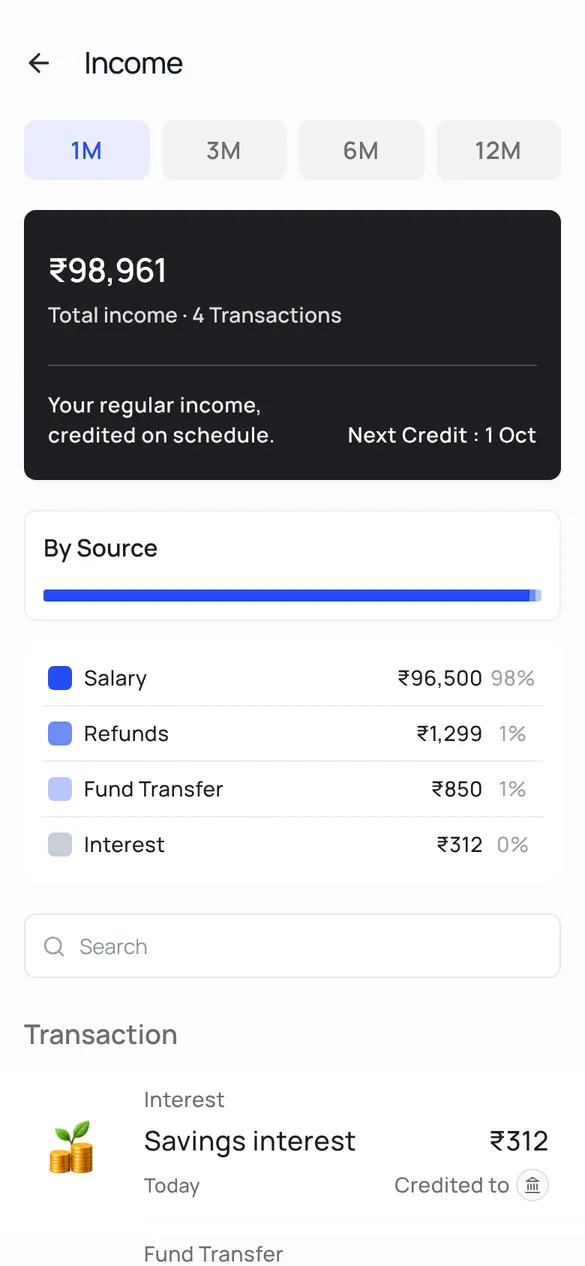
    Unyfy income screen showing total income for the month split by source into salary, refunds, fund transfer and interest

    1.Income by source

    Salary, refunds, transfers and interest on separate lines, with the next expected credit.

    Screens from the Unyfy app with sample data for a sample user, not the example on this page.

    Common questions

    What should an income tracker count as income?

    Only credits that would have arrived without you spending first: salary, interest, dividends and freelance pay. Refunds, cashback, reimbursements and repayments reverse spending. In the illustrative month, ₹1,67,429 was credited but real income was ₹1,27,530.

    How do I track income and expenses in India without counting refunds twice?

    File each refund, cashback credit or repayment against the purchase it reverses, in that purchase's month. Counted as income, a refund that crosses a month moves money between months: in the worked example, a ₹4,860 flight refund made the third month look better than it was.

    What should a salary tracker app show after a raise?

    The date the higher credit first landed and how much of the raise is still unallocated each month. In the example, ₹10,000 of a ₹13,200 raise is unallocated in month one and ₹3,400 by month three. Unyfy notices when the salary credit rises and shows the unallocated part; that income view is free.

    How do I track multiple income sources when freelance pay is irregular?

    Keep it in its own account, size fixed costs on salary alone, and pay yourself the median month rather than the average. On ₹2,40,000 a year with five empty months, paying the ₹20,000 average needs a ₹35,000 buffer; paying the ₹15,000 median needs ₹15,000 and leaves ₹60,000 at year end.

    Is dividend income tracking worth it for a small portfolio?

    Yes, mainly for the tax return. Dividends and interest are income from other sources, and the Annual Information Statement on the e-filing portal shows what was reported about you. For budgeting, annualise them: ₹7,800 of dividends a year is ₹650 a month, not a rich month whenever one lands.

    Why does my salary feel the same a few months after a raise?

    Because spending drifts up to meet it. In the illustrative case, drift reached ₹9,800 by month three, 74.2 percent of the raise, and the saving rate moved only from 21.8 to 22.2 percent. Stepping up a SIP on the first revised salary date prevents most of it.

    An income tracker earns its place by removing everything that is your own money coming back, which in the worked month cut apparent income from ₹1,47,429 to ₹1,27,530, and by watching the salary line for the month it changes. A 12 percent raise of ₹13,200 left ₹3,400 unallocated three months later, and more than half of what absorbed it had become an EMI or a mandate. Sort credits by whether they needed a purchase first, plan freelance on the median, annualise dividends and interest, and give a raise a job in the month it arrives.

    Our Partners

    Banks and NBFCs we compare

    Unyfy compares offers from these lenders and earns a commission if you take one. The comparison is shown first, and it can tell you not to switch.

    HDFC Bank logo
    ICICI Bank logo
    Axis Bank
    State Bank of India logo
    IDFC First Bank logo
    Kotak Mahindra logo
    IndusInd Bank logo
    Yes Bank logo
    Bajaj Finserv logo
    Tata Capital logo