Money Clarity

    Fixed expenses: the costs your monthly list leaves out

    Ask someone for their fixed expenses and they will list the home loan or rent, the car EMI, the SIP and perhaps the school van. That list is usually right about every item on it and wrong about the total, because the costs it leaves out are not paid monthly. In the illustrative household on this page, the monthly list comes to ₹40,524, 47.7 percent of an ₹85,000 take-home. Add the quarterly and annual bills spread across the year, and the utilities that arrive every month in a varying amount, and the committed figure is ₹60,904: 71.7 percent.

    The ₹20,380 between the two is not overspending. It is society maintenance, three insurance premiums, school fees and subscriptions billed once a year, all of which the household will pay whatever it decides, and none of which feels like a monthly cost because none arrives monthly. It turns a month that seems to leave ₹1,483 a day for food, travel and everything else into one that leaves ₹803.

    Below: a test that sorts any expense into fixed, semi-fixed or variable, the full list for this household with its yearly items turned monthly, what a single renewal price rise does over a year, and how to keep the list true after the day you make it.

    Last reviewed 2026-10-09

    Fixed expenses: why the list comes up short

    The technique

    Count by contract, not by month

    People build the list from memory of the last salary month. Anything billed quarterly or yearly was not in that month, so it is not on the list, though it is as certain as the EMI and was agreed just as firmly.

    Take a household that owns its flat, with ₹85,000 of take-home pay credited on the 1st, one child in school and one car. The figures are illustrative; the method works on any year of statements.

    The monthly items are easy to name. A ₹25 lakh home loan over 240 months at an illustrative 8.5 percent costs ₹21,696 a month. A ₹3.2 lakh car loan over 48 months at an illustrative 9.25 percent costs ₹8,001. Then a ₹4,000 SIP, ₹3,000 to the house help, ₹2,200 for the school van, ₹849 for a family mobile plan, ₹649 for broadband and ₹129 for a music plan. That is the list most people would write, and it totals ₹40,524.

    What it misses falls into two groups. The first is everything with a fixed price and an irregular month: society maintenance billed each quarter, property tax, a family health premium, a term insurance premium, car insurance, three school term fees plus annual charges, and three subscriptions renewed once a year. Together ₹1,53,598 a year, or ₹12,800 a month. The second is the bills that arrive every month in a different amount: electricity, piped gas and fuel for the daily drive, ₹7,580 in an average month.

    The yearly items go missing for a simple reason. Each is paid from a bonus, from savings or on a card, so each feels like a one-off, and each year it is a fresh surprise even though nothing about it was unknown.

    What the list says against what is committed
    Monthly items, the usual list
    ₹40,524
    Quarterly and annual items, spread monthly
    ₹12,800
    Semi-fixed bills, average month
    ₹7,580
    Committed before any choice
    ₹60,904
    Share of ₹85,000 take-home
    71.7%
    Left for everything else
    ₹24,096

    Illustrative household. Annual items are divided by twelve; semi-fixed bills use their average month.

    • The missing ₹20,380 adds 50.3 percent to the list the household would have written and is 24.0 percent of take-home. Over a year it is ₹2,44,560 that no plan was holding.
    • On the short list, ₹1,483 a day looks free. On the full one it is ₹803, which is ₹680 a day less, and that difference is where a month that looked comfortable starts running short.
    Fixed vs variable expenses: a test for each

    The technique

    Classify by predictability, not necessity

    Groceries are essential and variable; a streaming plan is optional and fixed. Sorting by need puts them the wrong way round, and a plan built on that sort cannot say what next month costs.

    Most advice splits spending into needs and wants. For planning, a better split is by how well you can predict the amount, because that decides how you plan for it. Three tests settle almost every line on a statement.

    Fixed: could you write down the rupee amount, and the month it falls due, a year ahead? If the only thing that changes it is a contract, a plan or an agreed arrangement, it is fixed. That covers EMIs, premiums, school fees, maintenance, subscriptions, the SIP and the house help, whether billed monthly or yearly.

    Semi-fixed: will it certainly arrive every cycle, but you cannot name the figure until the bill does? Usage or season moves it: electricity, piped gas, metered water, fuel for a fixed commute. Plan these with an average and a high, never the last bill.

    Variable: would it be zero next month if you decided so? Eating out, shopping, travel and most small UPI payments pass this test.

    Three lines trip people up. The credit card bill is not an expense at all but a container: the subscriptions charged to the card are fixed and belong on the list by name, while the swipes are variable. The SIP is fixed by choice, and it stays on the list because the money is gone on the day whatever you call it. Fuel is semi-fixed for someone who drives to work and variable for someone who drives at weekends.

    TypeThe testExamples hereHow to plan it
    Fixed, monthlyAmount and date known a year aheadEMIs, SIP, house help, school van, plansThe exact amount
    Fixed, periodicAmount known, month known, not monthlyPremiums, school fees, maintenance, yearly plansDivide by twelve and set aside
    Semi-fixedArrives every cycle, amount movesElectricity, piped gas, commute fuelAverage for the plan, high for the buffer
    VariableCould be zero if you choseEating out, shopping, travel, most UPIWhatever is left
    The card bill is split into its contents: subscriptions on the card are fixed, swipes are variable.
    • Essential and fixed are different questions. A household that treats groceries as fixed tends to underplan the yearly premium, because the list feels complete.

    A monthly fixed expenses list for ₹85,000 take-home

    Here is the monthly part in full, with the column most lists leave out: when each item ends or can next change. A list without it treats every line as permanent, and two of these are not.

    The two EMIs are ₹29,697, 34.9 percent of take-home, and they are the least movable lines on the page: they change only with a prepayment, a refinance or the last instalment. The car loan has 18 months left in this example. When it ends, ₹8,001 a month, 9.4 percent of take-home, stops leaving. Until then it still owes ₹1,44,018 of EMIs.

    The small lines are where a list goes stale. The mobile plan, broadband and music plan are ₹1,627 a month, ₹19,524 a year, and each can change price at its next cycle without anyone signing anything new. The order these leave the account after payday is the subject of the where-does-my-salary-go page; this page is about the total.

    ItemPer monthEnds or can change
    Home loan EMI₹21,696Rate reset, prepayment, 240 months
    Car loan EMI₹8,001Ends in 18 months
    SIP₹4,000Your choice
    House help₹3,000Agreed revision
    School van₹2,200Academic year
    Mobile family plan₹849Next billing cycle
    Broadband₹649Next billing cycle
    Music plan₹129Next billing cycle
    Total₹40,52447.7% of take-home
    Illustrative. EMIs computed on a reducing balance at the rates stated above.

    Annual and quarterly bills, turned monthly

    The technique

    Divide by twelve, then check the month

    Spreading a yearly bill across twelve months tells you how much to set aside. It does not tell you when the money leaves, and the months where lumps cluster can ask for more than the salary.

    List every debit from the last twelve months that repeats, but not monthly, and divide each by twelve. School is the biggest: three term fees of ₹21,000 and ₹8,500 of annual charges, ₹71,500 a year and 46.6 percent of all the periodic items. Insurance, across health, term and car, is ₹46,000 a year, ₹3,833 a month. Maintenance and property tax are ₹31,800, ₹2,650 a month. The three yearly subscriptions are only ₹4,298, ₹358 a month, which is exactly why they are the ones forgotten.

    The monthly figure, ₹12,800, is 15.1 percent of take-home. It is a planning number, not a payment. Suppose April carries the annual school charges, the first term fee, the first quarter's maintenance and the property tax: ₹40,600 in one month, ₹27,800 more than the monthly share. April's committed outflow then reaches ₹88,704, 104.4 percent of take-home, while a month with no periodic item commits only ₹48,104, 56.6 percent. Both are the same household with the same income. Mapping every month of the year is the predict-next-month-bills page's work.

    The practical fix is a standing transfer of the monthly share, ₹12,800, into a separate account on payday, from which the lumps are paid. The quiet months then stop looking rich.

    Periodic itemPer yearPer month
    Society maintenance, quarterly₹27,600₹2,300
    Property tax₹4,200₹350
    Family health premium₹22,400₹1,867
    Term insurance premium₹13,800₹1,150
    Car insurance₹9,800₹817
    School term fees, three terms₹63,000₹5,250
    School annual charges₹8,500₹708
    Streaming, yearly plan₹1,799₹150
    Cloud storage, yearly₹1,500₹125
    Shopping membership, yearly₹999₹83
    Total₹1,53,598₹12,800
    Illustrative amounts at the price last paid. Monthly figures are rounded.
    • Yearly billing is usually cheaper and harder to see. The streaming plan costs ₹1,799 a year against ₹199 a month, ₹2,388 over twelve months: a saving of ₹589, or 24.7 percent.
    • The saving holds only if the plan is used for at least nine months. Stop after five and monthly billing would have cost ₹995, so the yearly plan loses ₹804.
    • A yearly plan also renews in a month nobody is watching, which is why it belongs on the list with its renewal month beside it.

    Semi-fixed bills and the share already committed

    Semi-fixed bills need two numbers. Electricity here averages ₹2,300 and has ranged from ₹1,600 to ₹3,400 over the year. Piped gas averages ₹780, between ₹690 and ₹880. Fuel for the daily drive averages ₹4,500, between ₹3,800 and ₹5,600. The average month is ₹7,580 and the high case ₹9,880: a swing of ₹2,300 that the plan has to hold room for.

    Put the three parts together. On an average month the household has committed ₹60,904, 71.7 percent of take-home, and has ₹24,096 left, 28.3 percent, or ₹803 a day over 30 days. In the high case, with every semi-fixed bill at its peak, committed reaches ₹63,204, 74.4 percent, and the daily figure falls to ₹727.

    There is no universal right share. The useful check is whether the daily figure covers what the household genuinely spends on ordinary days. If it does not, the answer sits in the committed lines, not in groceries. Those lines move at different speeds: the EMIs only with a prepayment, refinance or the last instalment; the periodic items only at renewal; the semi-fixed bills with usage. Knowing which is which tells you when each can be changed, and the renewal date is usually the nearest one.

    The committed share, average and high
    Monthly fixed
    ₹40,524
    Periodic, spread monthly
    ₹12,800
    Semi-fixed, average / high
    ₹7,580 / ₹9,880
    Committed, average / high
    ₹60,904 / ₹63,204
    Share of take-home
    71.7% / 74.4%
    Left per day
    ₹803 / ₹727

    Illustrative. Semi-fixed ranges are the smallest and largest bills of the past twelve months.

    • Semi-fixed bills are 8.9 percent of take-home on average. Small as a share, but their swing of ₹2,300 is larger than any single subscription on the list.

    What one renewal price rise costs over a year

    The technique

    Update the list on the notice, not the debit

    A rise is announced once, as a percentage, and then forgotten because the list still shows last year's number. From the renewal onward the list is wrong, and every plan built on it inherits the error.

    Take the largest periodic item. Suppose the school raises fees by an illustrative 10 percent for the new academic year. ₹71,500 becomes ₹78,650: ₹7,150 more over the year, ₹596 a month. Measured against the ₹24,096 left for variable spending, that is 2.5 percent, which sounds small and is easy to absorb once.

    It does not stay once. A fee that rises by 10 percent at three renewals in a row goes from ₹71,500 to ₹95,166, 33.1 percent higher, and over those three years the household pays ₹45,831 more than the original fee would have cost. The list, if nobody updated it, still says ₹71,500 throughout.

    Rises rarely come alone. If in the same year the health premium rises 15 percent at renewal, maintenance is revised up 8 percent, and the broadband plan moves from ₹649 to ₹749, a 15.4 percent rise, the four together add ₹13,918 a year, ₹1,160 a month, 4.8 percent of the money left for choices. None of these percentages is a market average; your own renewal notices are the only figures that count.

    The point is not that prices rise. It is that a fixed expenses list records the price on the day it was made, and every renewal quietly makes it wrong.

    RenewalBeforeAfterExtra per year
    School fees, up 10%₹71,500₹78,650₹7,150
    Health premium, up 15%₹22,400₹25,760₹3,360
    Maintenance, up 8%₹27,600₹29,808₹2,208
    Broadband, ₹649 to ₹749 a month₹649₹749₹1,200
    All four₹13,918
    Illustrative rises, not market averages. Extra per month across all four: ₹1,160.
    • The moment to update the list is the fee circular or the renewal notice, which usually arrives weeks before the debit, not the debit itself when the money has already gone.
    • A renewal is also the one moment a periodic item can be dropped or changed. If a rise lands on something nobody uses, stopping it on the rail it runs on is covered on the cancel-upi-autopay-mandates page.
    • Rises on monthly plans are harder to notice than on yearly ones: ₹100 more on broadband is ₹1,200 a year and never arrives as a single surprising debit.

    How to track fixed monthly expenses, step by step

    The technique

    Twelve months, five columns

    Three months of statements catch the monthly items and miss most periodic ones by accident. Only a full year shows every premium, fee and renewal at least once.

    Pull twelve months of statements for every account and card the household pays from, including the one that only pays insurance.

    Go through the debits and keep anything that repeats at any interval: the same payee, a similar amount, monthly, quarterly, half-yearly or yearly. For each, record five things: the item, the amount last paid, how often it repeats, the month it next falls due, and the date it ends or can change. Then spread the periodic ones across twelve months, give each semi-fixed bill an average and a high, and add the three parts.

    A spreadsheet is enough to start. Its weakness is that it is right on the day it is made and decays from there: a new mandate appears, a premium renews higher, a loan ends and nobody deletes the row. So the list needs a review at three moments: when any renewal notice arrives, when a loan closes, and once a year against fresh statements.

    When is it not worth the effort? If the household rents, has few periodic items and its committed share leaves plenty, a monthly list is close enough. It earns its keep where yearly items are large, or where the daily figure left over is tight.

    • Search the year for the payees you expect, the insurer, the school, the housing society, and also for amounts you do not recognise; an unfamiliar yearly debit is often a renewal nobody chose.
    • Write the end date beside every loan. A fixed cost that ends is money that will need a destination, and deciding that in advance stops it drifting into spending.
    • Treat the card statement as part of the search. Yearly plans are often billed to a card and never appear on the bank statement under their own name.

    How Unyfy helps you track fixed expenses

    The work on this page is finding every cost that repeats, at any interval, and seeing next month's committed total before it arrives. Unyfy does that from your own transactions, read from bank and card transaction emails and, on Android, transactional SMS, with no manual entry.

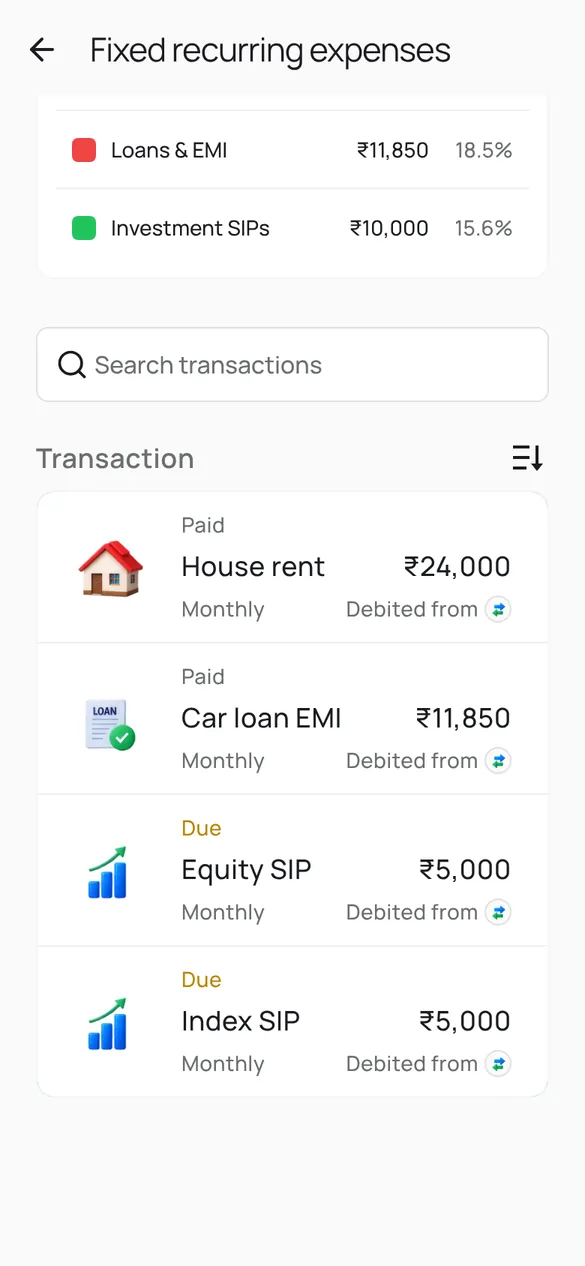
    On Pro, the Fixed Expenses screen predicts what the coming month is already committed to: the EMIs, SIPs, rent, premiums, bills, subscriptions and card bill it has seen leave your accounts, with what is paid and what is left so far this month, so the committed total is in front of you before the month begins rather than rebuilt from statements.

    Its Subscriptions list shows each recurring subscription with its amount and Due or Paid status. Open one and you see how often it is paid, the usual payment days, how many past payments matched and the past months' payments, so you can compare this month's amount with the ones before it.

    It never asks for your bank password or UPI PIN, and every payment is one you authorise. You cancel a plan with the provider, and a mandate in the UPI app that set it up. Install Unyfy on Android, or use the web app at app.unyfy.co.in on an iPhone.

    Unyfy Fixed Expenses screen listing rent, a car loan EMI and two SIPs, each marked paid or due this month

    1.Fixed recurring expenses

    Rent, EMIs and SIPs, each marked paid or due this month. On Pro.

    Screens from the Unyfy app with sample data for a sample user, not the example on this page. Fixed Expenses is a Pro feature.

    Common questions

    What counts as fixed expenses in India?

    Anything whose amount you could write down a year ahead, changing only when a contract or plan changes: EMIs, rent, the SIP, house help, school fees, insurance premiums, society maintenance, property tax and subscriptions, whether billed monthly or yearly. In the worked ₹85,000 household the monthly ones alone are ₹40,524, and the periodic ones add ₹12,800 a month once spread across the year.

    How do I track fixed monthly expenses accurately?

    Use twelve months of bank and card statements, not three, so every yearly premium and fee appears at least once. Keep every debit that repeats at any interval and record the amount last paid, frequency, next due month and end or renewal date. Divide the periodic ones by twelve, and review the list whenever a renewal notice arrives or a loan closes.

    What is the difference between fixed vs variable expenses?

    A fixed expense has an amount you can name in advance, set by a contract or plan. A variable one could be zero next month if you chose. Between them sit semi-fixed bills such as electricity and piped gas, which arrive every month in a varying amount and are best planned with an average and a high: here ₹7,580 and ₹9,880.

    What should a monthly fixed expenses list in India include?

    The obvious monthly debits, plus the items people leave off: quarterly maintenance, property tax, health, term and vehicle premiums, school term fees and annual charges, and subscriptions renewed yearly. In the worked example those add ₹1,53,598 a year. Add an end or renewal date beside each line, because a list without dates cannot show a loan ending or a price changing.

    How much of my salary is usually committed to fixed costs?

    There is no universal figure, and the one people quote for themselves is usually low. In the worked household the monthly list suggests 47.7 percent of take-home; the full count, with periodic and semi-fixed bills, is 71.7 percent, leaving ₹803 a day rather than ₹1,483. The test is whether the daily remainder covers ordinary spending.

    Is there a fixed expense tracker app that shows next month's commitments?

    Unyfy reads bank and card transaction emails and, on Android, transactional SMS. On Pro, at ₹99 a month, its Fixed Expenses screen predicts what next month is already committed to and keeps a Subscriptions list, each recurring subscription with its amount and whether it is due or paid. On iPhone, use the web app at app.unyfy.co.in, which reads your bank's email alerts and statements.

    Most fixed expense lists are accurate and incomplete. In this household the monthly items say 47.7 percent of take-home is spoken for; the full count, with periodic bills spread across the year and semi-fixed bills at their average, says 71.7 percent. Find the missing items in twelve months of statements, give each a renewal date, set aside ₹12,800 a month for the lumps, and update the list when a notice arrives rather than when the higher debit does.

    Our Partners

    Banks and NBFCs we compare

    Unyfy compares offers from these lenders and earns a commission if you take one. The comparison is shown first, and it can tell you not to switch.

    HDFC Bank logo
    ICICI Bank logo
    Axis Bank
    State Bank of India logo
    IDFC First Bank logo
    Kotak Mahindra logo
    IndusInd Bank logo
    Yes Bank logo
    Bajaj Finserv logo
    Tata Capital logo