Money Clarity

    Trip expense tracker: what your last trip really cost

    Ask four friends what their last trip cost and they will agree on a number within a minute. It will be short by more than a fifth. Not because anyone is careless, but because a trip is paid for in four places at four different times: bookings on a card weeks before you leave, UPI and card payments while you are there, cash that leaves the account as one ATM line, and a card bill that arrives after the photos have been shared. A trip expense tracker, whether a notebook or software, is only as good as the number of those places it looks in.

    This page works through one illustrative trip: four people, four days, three nights. The group remembers ₹80,000. The accounts say ₹1,03,000. Below is where the missing ₹23,000 went, how to find it in one sitting, how to split the real total when one person fronted most of it, and how to budget the next trip from it. Then the same problem stretched over seven months, which is what a wedding is.

    Last reviewed 2026-10-09

    What a trip expense tracker has to catch

    The technique

    Count by channel, not by memory

    Memory keeps the bookings and the big dinners. It drops the scooters booked separately, most of the 64 small UPI payments, the cash and the deposit that came back short. On this trip those come to ₹23,000, 22.3 percent of what the trip really cost.

    Four friends, Rohan, Kabir, Meera and Isha, take a four-day, three-night trip to the coast. About five weeks before, Rohan books everything on a credit card: return flights at ₹7,200 a head, ₹28,800 in all; a villa at ₹7,200 a night for three nights, ₹21,600; and two scooters for three days at ₹600 a day each, ₹3,600. That is ₹54,000 before anyone has packed.

    On the trip, Kabir and Meera pay for most things by UPI: food, fuel, short cab rides, a boat trip and entry fees, small shopping, water and tips. That is 64 payments averaging ₹450, ₹28,800 in all, ₹16,000 from Kabir's account and ₹12,800 from Meera's. Rohan puts three dinners and some shopping on the card, ₹11,200. Meera withdraws ₹5,000 on the first day and ₹3,000 on the third, and ₹900 of it comes home. Kabir pays ₹1,100 for the cab home from the airport. Isha paid the villa's ₹5,000 security deposit by UPI before the trip and gets ₹4,200 back nine days after it, the rest kept for a broken glass and extra cleaning.

    Add it up and the trip cost ₹1,03,000, or ₹25,750 a person. Ask the group a week later and they say about ₹80,000, twenty thousand each. They remember the flights and the villa to the rupee, ₹50,400, and put everything else at about ₹29,600. The real everything-else was ₹52,600.

    Where the ₹23,000 went
    Scooters, booked separately from the villa
    ₹3,600
    On-trip UPI and card spends beyond the remembered figure
    ₹10,400
    Cash spent (₹8,000 withdrawn, ₹900 came home)
    ₹7,100
    Airport cab home
    ₹1,100
    Villa deposit not refunded
    ₹800
    Remembered ₹80,000 against actual ₹1,03,000
    ₹23,000

    Illustrative trip with round figures, not a survey result. The remembered total is 77.7 percent of the real one; redo this on your own last trip with the statements open.

    • The largest single miss is not the cash. It is ₹10,400 of ordinary on-trip spending, because no payment in it was large enough to remember and there were 64 of them
    • The flights and villa are remembered exactly because they were the decision. Everything decided on the ground is remembered as a rough figure, and rough figures round down
    Why no single statement shows the trip

    The technique

    The trip is split by payer and by billing cycle

    Each person's account holds a slice, and the organiser's card splits that slice across two statements. The total exists only when someone adds the slices and removes the overlap.

    The gap is not only memory. The money is scattered, and each person sees a different trip.

    Rohan's card shows ₹65,200, but not in one place. The bookings were made five weeks out, so the ₹54,000 sits on the statement before the trip, read and paid in a month when the trip was still a plan. The ₹11,200 of dinners and shopping lands on the next statement, after everyone is home. Neither statement says trip. Kabir's account shows ₹17,100 of UPI debits to names that mean little a week later. Meera's shows ₹12,800 of UPI and two ATM withdrawals. Isha's shows ₹5,000 out and ₹4,200 back.

    Add the four views and you get ₹1,03,900, which is wrong by the ₹900 of cash that came home in Meera's wallet. A withdrawal is not spending; it moves money from the account to a pocket, and the pocket does not report back. This is the limit every method on this page shares. The statement records that ₹8,000 left the bank, and nothing records where ₹7,100 of it went.

    The same split happens to a festival that straddles a card statement date. Card spends of ₹14,000 before the date and ₹12,000 after, ₹15,800 by UPI and ₹5,000 in cash make a ₹46,800 festival. One card statement shows ₹14,000 of it, the next ₹12,000, and the bank account shows the rest as UPI rows and an ATM line. Why small UPI payments fall out of memory in ordinary months, across several payment apps, is covered on the page about tracking UPI spending.

    • The bookings statement is the misleading one: ₹54,000 paid in a month with no trip in it makes that month look expensive and the trip month look cheap, so both readings are wrong
    • Cash breaks every simple total. Count the withdrawal and you overstate by what came home; ignore it and you understate by what was spent

    How to track trip expenses in one sitting

    The technique

    Set the window first, then sweep every channel

    A trip starts on the day of the first booking and ends on the day the last refund lands. A window that opens at departure misses the largest item; one that closes at the return flight misses the deposit.

    Start by fixing the window. On this trip it runs from the booking date, five weeks before departure, to the day the deposit refund arrived, nine days after return: about seven weeks for a four-day trip. Then sweep each channel inside that window. Card statements for the bookings and the on-trip swipes, both cycles. The bank account of everyone who paid by UPI. ATM withdrawals made during the trip. Credits in the weeks after: refunds, returned deposits, a cancelled activity.

    Net each credit against what it reverses. Isha paid ₹5,000 and got ₹4,200 back, so the trip line is ₹800, not ₹5,000 and not zero.

    Treat cash as one line: withdrawals during the trip, less what came home. ₹8,000 less ₹900 is ₹7,100. Do not invent categories for it; an honest ₹7,100 marked cash beats a guessed split.

    Sort by category only after the total is right. Food and drink comes to ₹23,800 across UPI and card, local transport ₹4,900 including the cab home, shopping ₹4,300. Those are the lines that will change next time; the flights and villa will be quoted afresh anyway.

    • Do it within two weeks of getting home, while a UPI row with a cryptic name can still be matched to the beach shack or the fuel stop you remember
    • Ask each person for one number, what they paid inside the window, rather than a list. Four totals are enough to settle, and the lists are only needed if the totals look wrong
    • Keep the trip out of your ordinary monthly averages, or the next three months will look like savings that did not happen

    Splitting a group trip four ways, by hand

    The technique

    Settle on the real total, against what each paid

    The person who fronted the bookings is the one a remembered total hurts. Every rupee the group forgets was paid by someone, and when the group settles on memory, the organiser absorbs all of it.

    The arithmetic is simple, and someone in the group has to do it; a tracker that reads your own accounts shows your side of a trip, not who owes whom. Start from the actual total, ₹1,03,000, so each share is ₹25,750. Then compare each person's net payment with that share.

    Rohan paid ₹65,200 on the card. Kabir paid ₹17,100. Meera paid ₹19,900: ₹20,800 out of the account, less the ₹900 still in the wallet. Isha paid ₹800 net. Rohan is owed ₹39,450; Kabir owes ₹8,650, Meera ₹5,850 and Isha ₹24,950. Three transfers to Rohan and the trip is square.

    Now settle on the remembered ₹80,000, twenty thousand each, as many groups do. Kabir sends Rohan ₹2,900, Meera sends ₹100 and Isha sends ₹19,200. Rohan receives ₹22,200 and ends up ₹43,000 out of pocket while the other three are at twenty thousand each. Rohan has quietly paid ₹17,250 more than a fair share, which is ₹5,750 under-collected from each of the other three.

    Nobody meant it. Settling on a number that was too small left the whole difference with the person who paid first and most.

    PersonPaid, netFair shareTo settle
    Rohan₹65,200₹25,750Receives ₹39,450
    Kabir₹17,100₹25,750Pays ₹8,650
    Meera₹19,900₹25,750Pays ₹5,850
    Isha₹800₹25,750Pays ₹24,950
    Actual total ₹1,03,000 split four ways. Meera's figure is ₹20,800 out of the account less ₹900 of cash that came home; Isha's is the ₹5,000 deposit less the ₹4,200 refund.
    • If one person skipped part of the trip, say the boat ride, take that item out, split it among those who went, and split the rest by four
    • Settle before the organiser's second card statement is due, so Rohan is not paying the trip's bill out of their own money and waiting to be repaid

    Set the next trip budget from the last one

    The technique

    Price the ground cost per person per day

    Flights and stay are quoted before you go, so they need no history. The ground cost is what memory gets wrong, and it scales with people and days rather than with the destination's headline prices.

    Split the last trip into two parts. Flights and stay, ₹50,400, were known before departure and will be quoted again. Everything else, ₹52,600, is the ground cost, 51.1 percent of the trip, which surprises groups who think of a trip as its bookings. Over 16 person-days, four people for four days, that is ₹3,287.50; call it ₹3,288 a person a day.

    The next trip is the same four people for five days and four nights. Flights are quoted at ₹8,100 a head, ₹32,400, and a stay at ₹6,800 a night, ₹27,200. The ground cost is 20 person-days at ₹3,288, which is ₹65,760. The budget is ₹1,25,360, or ₹31,340 a person.

    Build the same budget from memory and the ground cost is ₹29,600 over 16 person-days, ₹1,850 a day, so ₹37,000 for the next trip and ₹96,600 in all. That plan is ₹28,760 short, ₹7,190 each, and the shortfall arrives in the same places as last time: small UPI payments, cash, and the card bill a month after.

    The per-day figure beats the total because it carries the group's habits: the meals, rides and small purchases a day come along on the next trip.

    • Adjust the per-day figure for the kind of trip, not for optimism. A city trip with more cabs, or a trek with no restaurants, changes it, and the change should come from a reason you can name
    • Collect the budget per person before anything is booked, ₹31,340 each here, and pay the bookings from that pool, so nobody fronts the whole of it on one card
    • If the trip repeats every year, it is a dated expense, and it belongs on the calendar of heavy months that the page on why some months cost more lays out

    Event expense tracker: a wedding over seven months

    The technique

    Track paid plus signed, not just paid

    A wedding is bought through advances and balances. The paid total lags the commitments by months, so on its own it reports the overrun after it can no longer be avoided.

    A trip spreads over seven weeks. A wedding spreads over seven months, and every problem above gets larger.

    Take a family hosting a wedding, with a budget of ₹9,00,000 set in the first month. The venue advance, jewellery, clothes, invitations and the caterer's advance go out over five months by transfer, card and UPI, as the table shows. The wedding month carries the caterer's balance of ₹1,80,000, decor at ₹95,000, guests' travel and rooms at ₹64,000, and ₹40,000 withdrawn in four ₹10,000 visits to the ATM for envelopes and tips: ₹3,79,000 in one month. The photographer's balance, ₹35,000, is paid the month after.

    The total is ₹10,22,000, which is ₹1,22,000 or 13.6 percent over budget. Only 37.1 percent of it was spent in the wedding month. The other ₹6,43,000, 62.9 percent, was spread across six months that each looked like an expensive month rather than a wedding.

    The overrun was visible in month five. By then ₹6,08,000 had been paid, which looks comfortable against ₹9,00,000, with ₹2,92,000 apparently left. But the caterer's balance, the decor and the photographer were already signed: ₹3,10,000. Paid plus signed was ₹9,18,000, ₹18,000 over budget before the ₹1,04,000 of guest travel and cash had even been priced.

    A wedding expense tracker that lists only what has left the account shows the paid column, the one that reassures. Keep each signed quote next to its debits and treat the remaining budget as the budget less both. Whether to save ahead or borrow for a dated event like this is worked through on the page about planning money for life events; this page is about seeing what it actually cost.

    MonthPaidAmountRunning total
    1Venue advance, bank transfer₹1,50,000₹1,50,000
    2Jewellery, card and transfer₹2,10,000₹3,60,000
    3Clothes, card and UPI₹86,000₹4,46,000
    4Invitations and return gifts, UPI₹42,000₹4,88,000
    5Caterer advance, transfer₹1,20,000₹6,08,000
    6Caterer balance, decor, guest travel, cash₹3,79,000₹9,87,000
    7Photographer balance, transfer₹35,000₹10,22,000
    Illustrative wedding with round figures and a ₹9,00,000 budget. The ₹40,000 of cash appears on the statement as four ATM withdrawals, with no record of the envelopes it became.

    When tracking is not worth it, and what to check

    Not every trip needs this. If one person paid for everything on one card inside one billing cycle, the statement is the tracker: filter the dates and add. A weekend drive with fuel, one hotel and a few meals is not worth an evening of reconciliation.

    Tracking also does not fix a trip that was too expensive for the people on it. If ₹25,750 each was more than two of the four could afford, the conversation that would have helped was before the ₹54,000 was booked.

    Where tracking is worth doing, by hand or with a travel expense tracker app, the same five questions decide whether its total can be trusted.

    • Does it see every channel: card, UPI from any payment app, bank transfers and ATM withdrawals? A tool that sees one payment app sees one person's UPI, which on this trip was ₹16,000 of ₹1,03,000
    • Does the trip start at the first booking rather than at departure? Here the ₹54,000 of bookings was paid five weeks before anyone left home
    • Does it net refunds and deposits against the original payment, so a returned deposit shows as an ₹800 cost rather than ₹5,000 or nothing at all
    • Does it keep out what is not the trip? An SIP, an EMI, the electricity bill or the monthly transfer to a parent can fall inside the trip dates. Counted, they inflate the trip; dropped silently, you cannot check what was left out
    • How does it show cash? From bank records it can only see the withdrawal
    • Does it need your bank password or UPI PIN? Reading what was paid needs neither, and a tool that asks has confused tracking with paying

    How Unyfy helps you track trips and events

    Unyfy reads your bank and card transaction emails and, on Android, your bank's SMS, so a trip's payments arrive without manual entry. It never asks for your bank password or UPI PIN. Trips are free and sit under Event log and trips, as Vacation, Official, Shopping or Event, with an optional name.

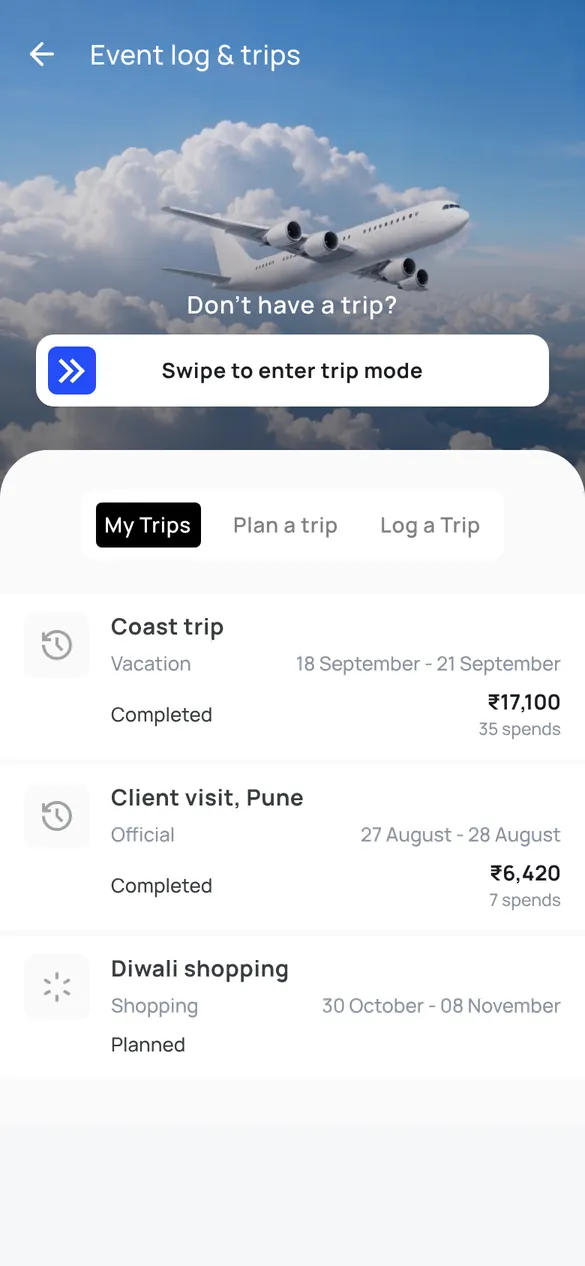
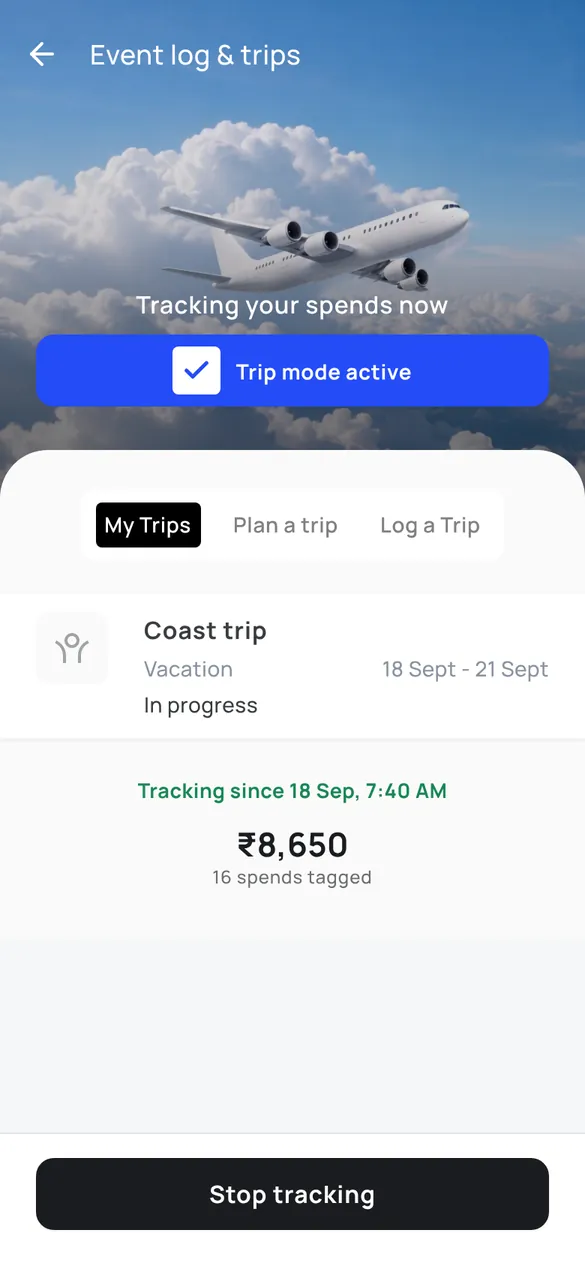
    There are three ways in. Swipe to enter trip mode as you leave, and it tags spends as they happen until you tap Stop tracking. Log a trip that already happened by setting when it started and ended, date and time. Or plan one for dates ahead.

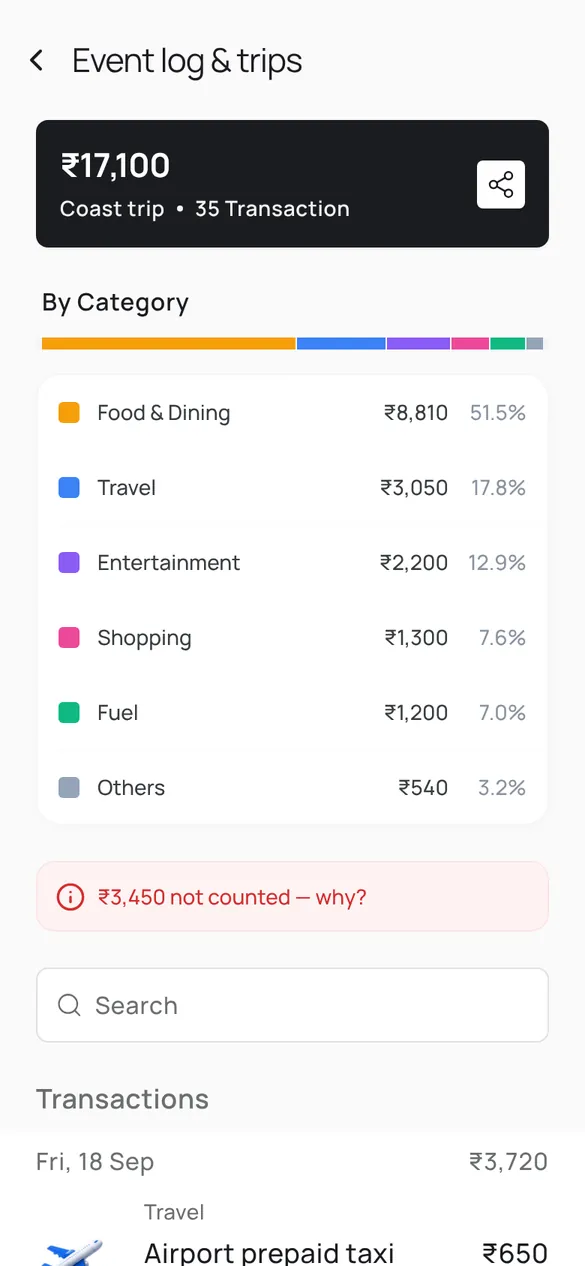
    The screens below show Kabir's side of the trip on this page: his ₹17,100 across 35 UPI payments. A trip opens on its total and transaction count, a By Category bar with each category's share, and the payments grouped by day with a total for each day. The share button sends the summary, and saving a trip locks it as a record.

    Payments that are not the trip are kept out automatically: investments, loan payments, routine bill payments and routine transfers to people you pay regularly. An SIP or an electricity bill that goes out mid-trip does not inflate the total, and nothing is dropped silently. The amount kept out shows as one line, not counted, and opens to the reasons.

    Each person's app shows their own payments, so Kabir sees his ₹17,100 of the ₹1,03,000 trip, and the group settles up with the split worked out above. On iPhone, use the web app at app.unyfy.co.in, which reads your bank's email alerts and statements. Install Unyfy on Android to start.

    Unyfy Event log and trips screen with the Swipe to enter trip mode control and a list of completed and planned trips

    1.Start or reopen a trip

    Swipe to enter trip mode, or open a past trip from My Trips.

    Trip mode active partway through a coast trip, showing the running total and the number of spends tagged so far

    2.Trip mode on

    Spends are tagged as they happen, with a running total. Stop tracking ends it.

    Unyfy trip summary for a coast trip showing the trip total, 35 transactions, spending by category with percentages and the amount not counted

    3.The trip total

    The total, the transaction count, a By Category bar with each category's share, and what was kept out.

    Screens from the Unyfy app with sample data: Kabir's ₹17,100 from the trip above, under sample merchant names. The other trips in the list are samples too.

    Common questions

    What should a trip expense tracker include?

    Everything paid between the first booking and the last refund, by every person and through every channel: card bookings made weeks before departure, on-trip UPI and card payments, ATM withdrawals less the cash that came home, and refunds or deposits netted against what they reverse. In the illustrative trip on this page, memory put a ₹1,03,000 trip at ₹80,000, and the difference sat in exactly those lines.

    How do I track trip expenses when different people paid?

    Fix the trip window, then ask each person for one figure: what they paid inside it. Add the four figures and remove two overlaps. Cash counts as withdrawals less what came home, and a deposit counts only as the part not refunded. In the example the four views add to ₹1,03,900, and removing the ₹900 of cash that came home gives the real ₹1,03,000.

    How do I split a group trip's cost fairly?

    Divide the actual total by the number of people, then compare each person's net payment with that share; those who paid less send the difference to those who paid more. On a ₹1,03,000 trip each share is ₹25,750 and three transfers settle it. Settling on a remembered ₹80,000 instead leaves the organiser, who fronted ₹65,200, ₹17,250 out of pocket.

    How much should I budget for my next trip?

    Take the last trip's ground cost, everything except flights and stay, and divide it by person-days. ₹52,600 over 16 person-days is about ₹3,288 a person a day. Multiply by the next trip's person-days and add fresh quotes for travel and stay. For four people over five days that gives ₹1,25,360, against ₹96,600 if the ground cost comes from memory.

    How do I track wedding expenses in India over several months?

    Keep two columns, paid and signed, because advances, balances and quotes arrive months apart and the paid total lags. In the illustrative wedding, ₹6,08,000 paid by month five looked safe against a ₹9,00,000 budget, but paid plus signed balances already came to ₹9,18,000. The final total was ₹10,22,000, and only 37.1 percent of it was spent in the wedding month itself.

    Can a travel expense tracker app see cash spending?

    No. A tracker that works from bank and card records sees an ATM withdrawal, not what the cash bought. The honest treatment is one line: withdrawals during the trip less the cash that came home, ₹8,000 less ₹900 in the example. Categories for cash exist only if someone noted them at the time; a tool that shows them without being told is guessing.

    Should an SIP, EMI or bill paid during a trip count as trip spending?

    No. Investments, loan payments, routine bills and regular transfers to family fall inside the trip dates without being part of the trip, so a total that includes them is overstated. Take them out, but keep a note of what you removed so the total can still be checked. Unyfy does this automatically and shows the amount kept out, with the reasons, on the trip's summary.

    A trip's cost is not hidden, only scattered: across four people, four channels, two card statements and a refund that lands after everyone has moved on. In the illustrative trip that scattering turns ₹1,03,000 into a remembered ₹80,000, leaves the organiser ₹17,250 out of pocket if the group settles on memory, and sets the next budget ₹28,760 short. The fix is one sitting: open the window at the first booking, close it at the last refund, sweep every channel, net the credits, count cash as one line, and price the next trip per person per day. For an event that runs over months, add what is signed to what is paid; that figure shows the overrun while there is still time to act.

    Our Partners

    Banks and NBFCs we compare

    Unyfy compares offers from these lenders and earns a commission if you take one. The comparison is shown first, and it can tell you not to switch.

    HDFC Bank logo
    ICICI Bank logo
    Axis Bank
    State Bank of India logo
    IDFC First Bank logo
    Kotak Mahindra logo
    IndusInd Bank logo
    Yes Bank logo
    Bajaj Finserv logo
    Tata Capital logo